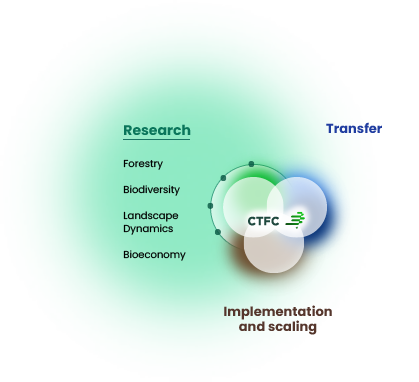
We conduct research in multifunctional forest management, developing tools and integrating expert knowledge that ensure the ecological, social, and economic values of forest ecosystems, to guarantee the sustainable provision of goods and services.
We model the dynamics of agroforestry systems to promote close-to-nature silvicultural practices that foster adaptation to socio-environmental changes.
We innovate in multifunctional forest planning to support management and agroforestry restoration at different spatial scales.
We carry out applied research for biodiversity conservation and sustainable management of natural systems. Through the study of the biology and ecology of populations, habitats, and threatened species, we model the factors that determine species distribution.
We support public administrations in the integration and analysis of information, as well as in the creation of innovative planning tools that improve decision-making in relation to the management of natural systems and biodiversity conservation.
We conduct pioneering research on the analysis of landscape dynamics and planning to provide effective responses to the growing pressure on natural ecosystems and to current scenarios of increased vulnerability as a consequence of the increased frequency of extreme weather events.
Through research, we aim to analyse new dynamics, pressures, and risks for natural and agropastoral areas associated with changes in land use, the productive and social fabric of mountain and rural territories, and urbanization processes. Through this analysis, we promote a cross-sectoral, multi-level, and multi-actor territorial management model that ensures forest management, biodiversity conservation, while enabling the provision of ecosystem services.
We are trailblazers in developing a circular bioeconomy research program in the forestry field. We design and implement innovative and transformative bioeconomy models, understood as a circular and sustainable economic model based on the use of renewable and local biological resources to produce goods and services across all economic sectors.
The bioeconomy is closely linked to research, innovation, and value-chain competitiveness, climate change mitigation, and economic and social development in rural areas.